
F-35 Fighter Aircraft
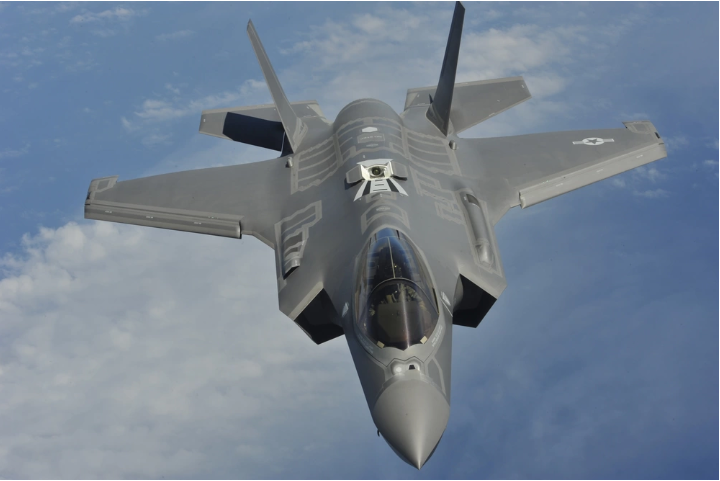
EGLIN AIR FORCE BASE, FLORIDA, UNITED STATES ,Credit: Photo by: Master Sgt.Donald Allen
Everything about F-35 Lightning II
The F-35 Lightning II, developed by Lockheed Martin, is a cutting-edge, fifth-generation multirole stealth fighter aircraft. Designed to fulfil various military needs, it offers advanced stealth capabilities, precision targeting, and unmatched versatility. The F-35 plays a pivotal role in modern air combat, enabling missions that range from air superiority and ground attack to reconnaissance and electronic warfare. Its development stems from the Joint Strike Fighter (JSF) program, an initiative aimed at creating a universal platform for multiple military branches and allied nations.
The F-35 had its first flight in 2006. It entered service with the U.S. Marine Corps in July 2015 (F-35B) and with the U.S. Air Force in August 2016 (F-35A).
Distinctive Features
- Stealth Technology
- The F-35 incorporates advanced stealth design, minimizing its radar and infrared signatures. This allows it to operate effectively in highly contested environments, reducing detection by enemy systems.
- Three Variants for Diverse Needs
- The F-35 is available in three configurations tailored to specific operational requirements:
- F-35A: Standard take-off and landing, used mainly by air forces.
- F-35B: Short take-off and vertical landing, suitable for operations in confined spaces or aboard amphibious assault ships.
- F-35C: Carrier-capable, optimized for naval operations.
- The F-35 is available in three configurations tailored to specific operational requirements:
- Integrated Sensor Systems
- The aircraft’s sensors gather and synthesize data in real time, providing pilots with a complete picture of the battlespace. This ensures better decision-making and increases mission success rates.
- Flexible Armament Options
- Equipped with internal weapon bays for stealth missions and external hard points for larger payloads, the F-35 can carry a mix of air-to-air and air-to-ground weapons, as well as advanced munitions for precision strikes.
International Reach
The F-35 serves as a key component in the defence strategies of several nations. Operators include the United States, United Kingdom, Japan, Italy, Australia, and others. Its adoption by allied countries fosters greater interoperability during multinational operations.
Potential Future Operators
Other nations, such as Czech Republic, Romania, and India, have expressed interest or are considering the F-35 for their defence needs.
Challenges and Critiques
While revolutionary, the F-35 program has faced challenges:
- Cost Concerns: With an estimated lifetime cost exceeding $1 trillion, it is among the most expensive defence programs ever undertaken.
- Development Hurdles: Delays and technical issues during testing slowed its deployment.
- Maintenance Requirements: The aircraft’s complex systems demand highly specialized support, increasing operational costs.
Transforming Modern Warfare
The F-35 has redefined how air forces approach combat operations. Combining stealth, intelligence-sharing, and adaptability, it enables nations to maintain air superiority against evolving threats. Despite its challenges, the F-35 is set to remain a cornerstone of global defence strategies, influencing air power for decades to come.
The F-35 Lightning II has seen operational deployment in several conflicts, showcasing its advanced capabilities in real-world scenarios. Though its combat role has been limited, the aircraft has made a significant impact where used.
- Israeli Air Force Operations
The Israeli Air Force (IAF) was the first to deploy the F-35 in combat.
- Region: Middle East
- Details: Israel’s modified version, the F-35I “Adir,” has been used in various airstrikes targeting installations in Syria and other neighbouring regions. These missions include neutralizing advanced weaponry, missile stockpiles, and facilities associated with Iranian forces or their allies.
- Outcome: The F-35 demonstrated its ability to penetrate advanced air defence systems, such as the Russian S-300 and S-400, while remaining undetected.
- United States Deployments
The U.S. has utilized its F-35s in various theatres of operation.
- Conflict Areas: Afghanistan, Iraq, and Syria
- Operations:
- The U.S. Marine Corps first used the F-35B in 2019 during strikes against Taliban positions in Afghanistan.
- The U.S. Air Force deployed the F-35A for precision strikes targeting ISIS command centres and infrastructure in Iraq and Syria.
- Significance: These missions demonstrated the aircraft’s effectiveness in delivering precise attacks while leveraging its stealth and advanced sensors to avoid detection.
- United Kingdom Deployment
The United Kingdom has deployed its F-35B aircraft in coalition operations.
- Region: Iraq and Syria
- Details: In 2021, British F-35Bs operated from the HMS Queen Elizabeth aircraft carrier as part of an international task force. These jets conducted airstrikes against ISIS targets and contributed to intelligence-gathering operations.
- Impact: This deployment highlighted the F-35’s ability to function effectively in carrier-based operations and as part of multinational missions.
- Japanese Surveillance and Regional Security
Although Japan has not used its F-35s in direct combat, the aircraft has been instrumental in strengthening regional security.
- Area: Indo-Pacific
- Role: Japanese F-35As have conducted patrols and surveillance missions amid rising tensions with China and North Korea.
- Benefit: The aircraft’s ability to gather intelligence and provide comprehensive situational awareness has bolstered Japan’s defensive posture.
Future Potential and Emerging Threats
The F-35 is poised to play a larger role in potential future conflicts, such as:
- Europe: NATO members could rely on the F-35 for air superiority in response to increasing tensions with Russia.
- Asia-Pacific: Rising geopolitical tensions in the South China Sea and Taiwan Strait may prompt greater deployment of the F-35 in reconnaissance or combat scenarios.
Strengths in Combat Deployment
- Stealth: Capable of operating undetected in areas with advanced enemy air defences.
- Precision: Delivers accurate strikes, minimizing collateral damage.
- Sensor Fusion: Integrates battlefield data for superior situational awareness.
- Interoperability: Seamlessly collaborates with allied forces for coordinated missions.